Table of Contents
Investor’s guide to get technological insights of platforms in the modern business landscape for informed decision making.
Introduction: The Digital Transformation Imperative
As the financial services industry undergoes a sweeping digital transformation, legacy infrastructure and physical distribution models are being replaced by agile, scalable, and user-centric platforms. It would not be a stretch to say that India leads this transformation. The scale of UPI today is remarkable. In June 2025 alone, it handled over ₹24.03 lakh crore in payments. Digital lending, Open banking, Insurtech, Wealthtech continue to expand.
Yet, beneath the surface of growth lies a critical question: Is the underlying technology truly equipped for scale, security, and sustainability?
This is where Platform Diagnostic or commonly used term Technology Due Diligence (TDD) plays a vital role. Far more than a technical inspection, TDD functions as a strategic lens through which businesses, top management, investors, and acquirers can evaluate the maturity, adaptability, and resilience of a technology ecosystem.
Key Stakeholders in a technical due diligence have priorities such as
- Investors/Acquirers - Focus on technical risks, scalability, integration costs, and competitive advantages
- Management Teams - Care about Business future demands, operational continuity, resource needs, and timeline for improvements
- Technical Leaders - Emphasize platform resilience, architectural improvement, code quality, security gaps, and modernization requirements
A sound platform diagnostic or TDD not only validates the resilience of technology in the present but also ensures that as systems scale and business expands in the future, the technical capabilities stay rock solid and flexible in terms of architectural robustness and ever evolving technological innovations.
What Is Platform Diagnosis/Technological Due Diligence?
Think of TDD as a thorough health checkup for your technology ecosystem. Just as a medical examination reveals both visible symptoms and underlying conditions, TDD uncovers not only what’s working well but also hidden vulnerabilities that could impact future performance. At its core, TDD is a systematic evaluation that examines every facet of a company’s technology infrastructure, from the quality of software and security protocols to the skills of the technical team and adherence to regulatory requirements.
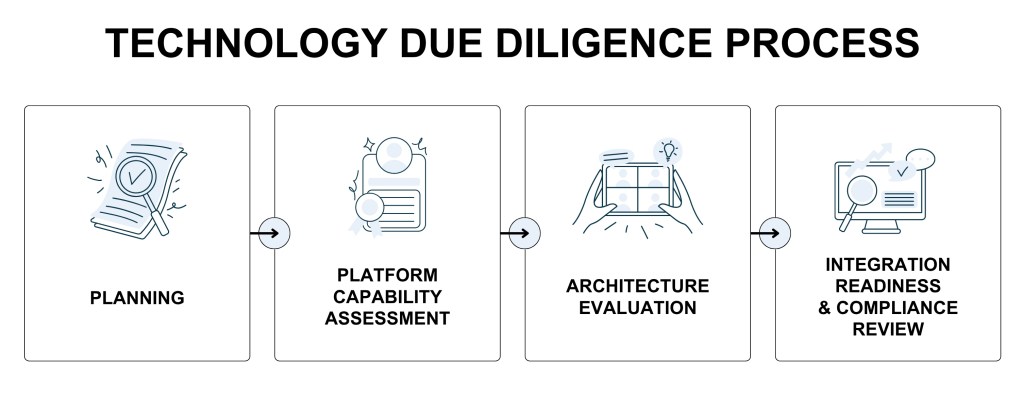
- The evaluation typically covers:
- Architecture and design: How modular, resilient, scalable, and robust is the system?
- Development processes: Is the version control and QA automation, driven through DevOps, mature?
- API and integration readiness: Are APIs standardized, secure, and well-documented?
- Cybersecurity posture: Is data encrypted, access managed, and incident response defined?
- Team and governance: Does the technical leadership & governance framework align with growth objectives as well in position to address stringent regulatory requirements?
Modern TDD also encompasses the evaluation of Application Programming Interfaces (APIs) or Microservices that facilitate integration with existing financial systems and third-party applications. In today’s interconnected digital ecosystem, the ability to seamlessly integrate with partners, vendors, and service providers often determines the difference between market leadership and obsolescence.
When and Why is Diagnostic Critical
The timing of platform diagnosis can make or break strategic business decisions. TDD becomes absolutely critical during pivotal moments when organizations stand at technological crossroads, facing decisions that will shape their future trajectory for years to come.
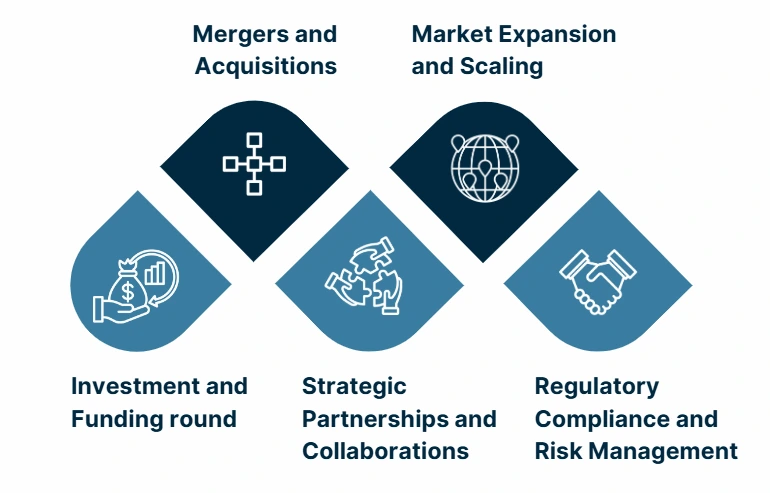
Investment and Funding Rounds
For investors, TDD has become an indispensable tool for assessing fintech or platform potential.
During funding rounds, TDD provides investors with a clear picture of risks and rewards associated with a company’s technological foundation, enabling informed capital allocation decisions.
Mergers and Acquisitions
When companies consider mergers or acquisitions, Technology Due Diligence acts as a strategic lens that reveals whether two technological ecosystems can successfully integrate, and be a strategic fitment to the acquirer’s future vision.
It identifies potential compatibility issues, assesses the effort required for system integration, and evaluates whether the combined entity will emerge stronger or face operational challenges that could undermine the transaction’s value.
Strategic Partnerships and Collaborations
In today’s collaborative business environment, Technology Due Diligence plays a crucial role in evaluating potential partnerships. Whether it’s a traditional bank considering collaboration with a fintech startup or two companies exploring joint ventures, TDD ensures that technological capabilities align with partnership objectives and that both parties can deliver on their promises.
Market Expansion and Scaling
As organizations prepare for geographical expansion or significant scaling of operations, TDD becomes essential for determining whether existing technology infrastructure can support growth ambitions. It identifies limitations that could affect scalability and recommends enhancements needed to support increased transaction volumes, user bases, and operational complexity.
Join Our Newsletter
Get exclusive insights on banking, fintech, regulatory updates and industry trends delivered to your inbox.
Regulatory Compliance and Risk Management
With regulatory requirements constantly evolving, particularly in the financial services sector, TDD helps ensure that technology systems remain compliant with changing standards. This is especially critical given the heavily regulated nature of BFSI (Banking, Financial Services, and Insurance) sectors, where non-compliance can result in severe penalties and reputational damage.
Core Components of a Tech DD
Effective Technology Due Diligence encompasses several critical components, each providing unique insights into different aspects of an organization’s technological capabilities. For easy navigation, we have identified five fundamental pillars that collectively provide a comprehensive assessment of technological health and potential.
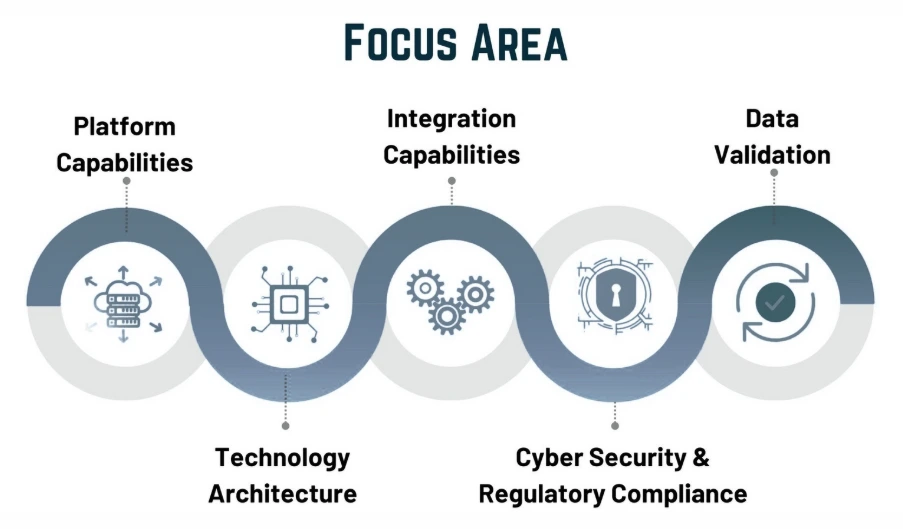
Technology Architecture Evaluation
The technical examination deepens when we scrutinize deployment processes, integration robustness with external systems, and most importantly, the platform’s ability to scale. This involves meticulous assessment of performance metrics, fault tolerance mechanisms, and overall system resilience.
- Technology Due Diligence investigates:
- Cloud-native readiness, containerization, and microservices adoption
- Scalability under load and disaster recovery mechanisms
- Technical documentation quality and developer toolchains
An architecture evaluation should encompass both current state assessment and future readiness analysis. This forward-looking perspective ensures that technology investments remain valuable as business requirements evolve.
Integration Capabilities Analysis
This analysis digs into the ecosystem of available APIs, focusing not only on their existence but also on their documentation quality and ease of third-party integration. Additionally, TDD investigates historical integration challenges and analyzes the API gateway architecture to ensure smooth interconnectivity.
- Technology Due Diligence checks if systems are designed for ecosystem participation:
- REST or GraphQL APIs with version control and proper security
- Availability of SDKs, testing sandboxes, and onboarding guides
- API gateways, rate limiting, and throttling policies
Cybersecurity Framework Review
- Technology Due Diligence evaluates:
- Data encryption at rest and in transit
- Access control, multi-factor authentication, and secure coding practices
- Incident response procedures and past security audits
With the average cost of a data breach exceeding $4 million globally, a focus on Cybersecurity Framework cannot be an afterthought.
Regulatory Compliance Verification
Regulatory compliance evaluation involves navigating through all applicable regulations, including Digital Lending Guidelines (DLG), LSP regulations, and other sector-specific requirements. It includes conducting intellectual property reviews of both paid and open-source software and performing source code sanity checks to prevent infringement issues.
- Technology Due Diligence (TDD) confirms the organization’s alignment with relevant laws and licensing requirements::
- Adherence to RBI, PCI-DSS, and DPDPA frameworks
- Usage of open-source components within appropriate license terms
- Source code ownership clarity and IP rights documentation
A robust compliance verification extends to evaluating the organization’s ability to adapt to changing regulatory requirements.
Success Factors of Effective Tech DD
A well-executed Platform Diagnosis/TDD is not just about inspecting the tech stack—it’s about delivering strategic clarity. “Success” for investors or acquirers means that TDD should illuminate the value, risks, and post-deal reality of the technology which is being bet on.
A successful TDD gives the investor clear guidance on whether to proceed, pause, or renegotiate the deal. It reveals the true cost of scaling, the depth of risk exposure, and the operational effort required to transform the technology into a strategic asset.

The Investor / Acquirer’s Point of View
“I want to know whether I’m investing in scalable tech or buying a liability.”
From the perspective of an investor, venture fund, or acquiring company, the success of a TDD hinges on one central question: Will the technology platform support our growth and value thesis, or will it introduce cost, complexity, and execution risk post-deal?
The key elements of a successful TDD from this standpoint include:
Clear Risk Visibility
Investors want risk demystified. Risks must be categorized as High, Medium, or Low, with a clear explanation of tech debt, scalability constraints, compliance gaps, and infrastructure fragility.Commercial Readiness Insight
The assessment must answer: Can this platform handle 10x growth without breaking? Is the system modular or tightly coupled? How easily can it onboard new products, markets, or lending partners? The goal is to gauge how future-proof the technology is.Integration & Exit Feasibility
Investors often need to know whether the target’s systems can be merged with existing platforms or alternatively, phased out without excessive cost or risk. TDD should flag potential IP or licensing issues that could complicate M&A execution.
Post-deal Execution Plan
A winning TDD doesn’t stop at diagnosis—it projects what needs immediate fixing, what can be deferred, and what can create immediate ROI. It helps investors model true cost and time-to-value in the post-acquisition integration phase.
Conclusion: The Strategic Imperative
Technology Due Diligence has evolved from a technical exercise to a strategic imperative that shapes the future of organizations across industries. In an era where technology capabilities often determine competitive advantage, market positioning, and long-term viability, TDD provides the insights necessary for informed decision-making.
As the digital landscape continues to evolve, the importance of thorough Technology Due Diligence will only increase. Organizations that invest in comprehensive TDD position themselves for sustainable growth, reduced risk, and enhanced competitive positioning. Those that overlook this critical process often discover costly technology limitations, only after making irreversible strategic commitments.
The future belongs to organizations that can effectively leverage technology to create value, manage risk, and adapt to changing market conditions. Technology Due Diligence provides the roadmap for achieving these objectives, transforming technology from a potential liability into a strategic asset that drives business success.