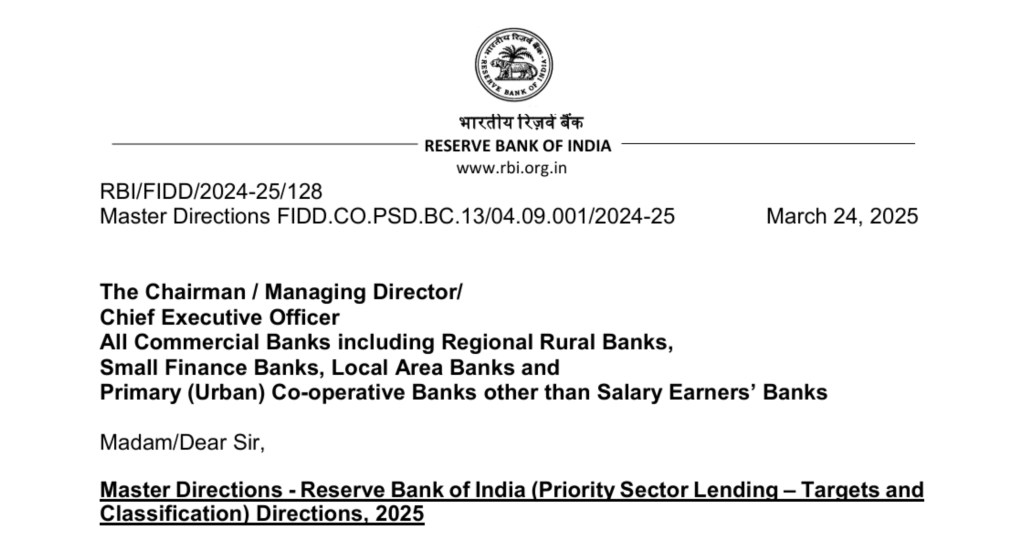
Priority Sector Lending 2025: A Strategic Reset for Inclusive Credit

On April 1, 2025, the Reserve Bank of India (RBI) issued the updated Master Directions on Priority Sector Lending (PSL), replacing the 2020 circular. These changes are not just operational—they represent a strategic reorientation aimed at addressing regional credit imbalances, enhancing financial inclusion, and aligning credit allocation with national development goals.
Priority Sector Lending 2025 RBI

The updated framework introduces differentiated district-wise targets, expanded PSL categories, clearer guidance on start-ups, renewable energy, and housing, and a stronger focus on data-driven compliance. Institutions are now required to adapt their systems and strategies in alignment with this broader policy vision

What is ANBC and Why It Matters?

Adjusted Net Bank Credit (ANBC) is the foundational base used to determine PSL targets for all banks.

Formula Overview:

ANBC is calculated as:

  • Net Bank Credit (NBC), excluding bills rediscounted with the RBI and other approved financial institutions,
  • Plus investments made by banks in non-SLR bonds held in the HTM category,
  • Minus eligible deductions (like long-term infrastructure bonds).

For foreign banks, the Credit Equivalent of Off-Balance Sheet Exposures (CEOBSE) is used when it exceeds ANBC.

Why It Matters:

  • PSL targets (e.g., 40% of ANBC for commercial banks) are computed using ANBC.
  • A higher ANBC increases a bank’s absolute PSL lending requirement.
  • Incorrect ANBC computation can lead to underachievement, regulatory penalties, and misaligned product strategies.

Example: A bank with ₹1,00,000 crore ANBC must lend ₹40,000 crore under PSL. If its rural district share is low, the new 125% weightage can offer an opportunity to rebalance.

Changes in PSL Categories & Sub-Categories

  • Housing Loans: Revised upward to ₹50 lakh (for Tier-1 cities) with a property cost cap of ₹63 lakh.
  • Renewable Energy: Expanded to include battery storage, EV charging, bio-energy.
  • Start-ups: Recognized as PSL under “Others” up to ₹50 crore.
  • Social Infrastructure: Loan caps raised to ₹10–12 crore.
  • Weaker Sections: Now includes transgender individuals.

Impact on the Credit Market

  • Prioritization of low-credit districts.
  • NBFC/HFC co-lending roles clarified.
  • Decreased dependency on PSLCs.
  • Emergence of new PSL-aligned credit products

Macroeconomic Implications

  • Inflation moderation via agri/infra funding.
  • Employment boost in MSMEs, housing, green infra.
  • Balanced regional growth.

The Digital Fifth’s Perspective

1. Embed PSL logic at origination.
2. Use heatmaps to guide district sourcing.
3. Build co-lending architecture with rule-driven APIs.
4. Deploy real-time compliance dashboards.

“PSL by design is the future. Institutions that align strategy with compliance will lead the next wave of financial inclusion.”

RELATED POSTS