Table of Contents
Unlocking Excellence: The Power & Purpose of Platform Benchmarking
In today’s competitive digital ecosystem, intuition-driven strategies are no longer sufficient to maintain market leadership. Organizations must drive their strategic decisions through robust data analytics and systematic performance measurement. This is where benchmarking emerges as a critical differentiator, providing the clarity, direction, and evidence-based roadmap necessary for sustainable competitive advantage.
According to recent industry research, 91% of enterprises recognize that today’s digital landscape demands a comprehensive digital product strategy from every business seeking market relevance.
Understanding Platform Benchmarking in the Digital Context
Strategic Framework for Platform Performance Assessment
1. Define Clear Objectives
Establishing precise, focused objectives forms the cornerstone of effective benchmarking initiatives. Without well-articulated goals, benchmarking efforts risk becoming diffused, misaligned with strategic priorities, or too broad to generate actionable insights.
Essential Components:
- Strategic Goal: Align benchmarking initiatives with overarching organizational objectives
- Operational Scope: Define specific platform components, features, or processes for assessment, focusing on business-critical, underperforming, or strategically vital areas
- Strategic Rationale: Document the business case and strategic importance of the selected focus area
- Comparison Framework: Establish whether benchmarking aims for:
- Parity: Achieving industry standard performance
- Differentiation: Outperforming targeted competitors
- Leadership: Establishing best-in-class practices
- Success Metrics: Define specific, measurable outcomes that will validate objective achievement
2. Establish Key Performance Indicators (KPIs)
Develop performance indicators that are both strategically meaningful and comparatively relevant across platform ecosystems. This requires a balanced approach incorporating both quantitative metrics and qualitative assessments.
Ecosystem Architecture & Strategic Design
Your platform’s market positioning, whether as a comprehensive super-app, specialized marketplace, or embedded solution, depends on the breadth of its service portfolio, the depth of third-party integration, and its value chain coverage strategy.
Critical Metrics:
- Service category coverage and diversity
- Active partner ecosystem size and engagement
- Revenue distribution between marketplace transactions and core offerings
Technology Infrastructure Excellence
Future-ready architecture balances scalability requirements with security imperatives through strategic cloud adoption, modular microservices architecture, and sophisticated API management, supported by comprehensive compliance frameworks and encryption standards.
Performance Indicators:
- Cloud adoption ratio (public/hybrid deployment)
- Microservices and containerization metrics
- API portfolio size and management efficiency
- Security certification and compliance standards
Revenue Model Optimization
Sustainable growth requires diversified revenue streams encompassing transaction fees, subscription models, commission structures, advertising revenue, and interest margins, complemented by strong unit economics and effective cross-selling performance.
Key Measurements:
- Platform fee contribution to total revenue
- Average Revenue Per User (ARPU) trends
- Multi-product adoption rates among the user base
- Partnership & API Strategy Excellence
Market expansion and innovation acceleration demand comprehensive API portfolios, streamlined partner onboarding processes, and mutually beneficial strategic alliances, including co-branded offerings and embedded finance solutions.
Strategic Metrics:
- Public API availability and adoption
- Partner onboarding velocity and efficiency
- Co-branded product market penetration
- Partner channel transaction volume percentage
- Customer Engagement & Digital Transformation
Platform success is defined by active user engagement and digital channel migration: user and merchant base growth, online transaction frequency, and new feature adoption rates.
Engagement Indicators:
- Monthly Active Users (MAU) growth trajectory
- Digital transaction share versus traditional channels
- Average transactions per user
- Customer satisfaction metrics (NPS, CSAT, app store ratings)
- Platform Scalability & Operational Excellence
Operational excellence requires seamless peak load management delivering high throughput, supporting massive concurrent user volumes, maintaining industry-leading uptime, and optimizing per-transaction costs.
Operational Metrics:
- Peak Transactions Per Second (TPS) capacity
- Concurrent user support capability
- System uptime percentage (targeting 99.9%+)
- Average response latency
- Cost-per-transaction across digital and traditional channels
Join Our Newsletter
Get exclusive insights on banking, fintech, regulatory updates and industry trends delivered to your inbox.
3. Select Strategic Benchmarking Targets
Once objectives and scope are clearly defined, identifying appropriate comparison targets becomes critical. Effective benchmarking depends on meaningful, relevant comparisons that generate credible and actionable insights.
Selection Criteria:
| Criterion | Description |
| Contextual Alignment | Operate within similar regulatory, business, and user environments |
| Strategic Relevance | Represent platforms you aspire to compete with or learn from |
| Data Accessibility | Provide accessible, comparable metrics and insights |
| Temporal Currency | Utilize current or recent data to ensure relevance |
4. Data Collection, Analysis & Gap Identification
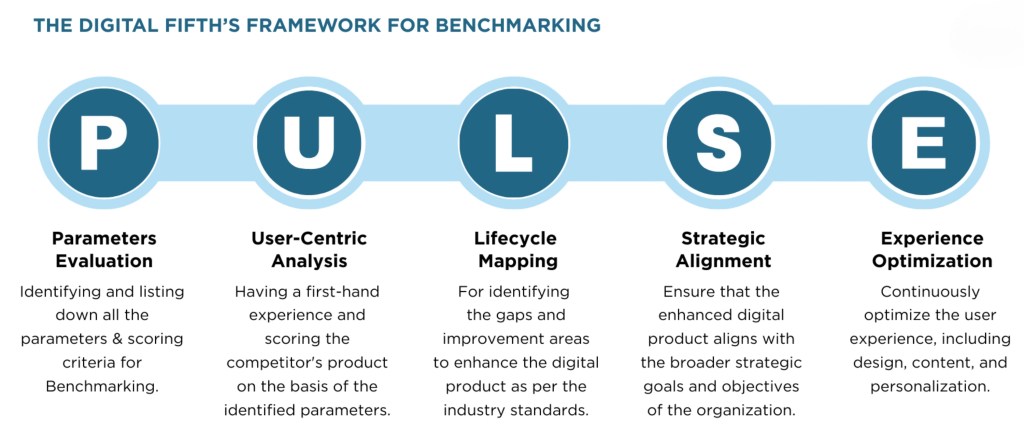
The Digital Fifth’s PULSE Framework: A Strategic Compass
The PULSE Framework serves as a comprehensive navigation tool in the dynamic digital landscape, guiding organizations toward exceptional user experiences that maintain industry leadership. This methodology elevates product evolution, deepens user understanding, and aligns strategic execution for sustained success.
Framework Components:
- Parameter Evaluation (P): Systematically identifies user pain points and performance bottlenecks
- User-Centric Analysis (U): Employs usability testing and user-first methodologies to understand deep user needs and expectations
- Lifecycle Mapping (L): Provides comprehensive customer journey visualization, identifying conversion drop-offs and optimization opportunities
- Strategic Alignment (S): Ensures implemented changes address customer needs while driving strategic business objectives
- Experience Optimization (E): Emphasizes continuous monitoring and iterative improvement based on data insights and user feedback
5. Develop Strategic Recommendations
Bridging Benchmarking Insights and Implementation Excellence
Transform strategic insights into actionable implementation roadmaps through the following approach:
Implementation Strategy:
- Strategic Prioritization: Analyze identified gaps and opportunities, prioritizing initiatives with maximum impact on customer experience and business outcomes
- Data-Driven Decision Making: Leverage benchmarking data to identify performance trends, competitive advantages, and optimization opportunities for user experience enhancement
- User-Centric Journey Design: Integrate user feedback with benchmarking insights to prioritize improvements addressing genuine customer pain points, ensuring changes meet unique demographic needs rather than merely replicating competitor features
- Stakeholder Alignment: Communicate findings and action plans effectively across organizational levels, fostering collaborative implementation and understanding
- Conversion Funnel Optimization: Analyze customer journey performance against top performers to identify improvement opportunities and drop-off reduction strategies
- Continuous Monitoring & Adaptation: Track implementation impact using established KPIs, maintaining progress monitoring and strategic adaptation based on ongoing insights

Objective Performance Assessment
Data-driven benchmarking enables fintech teams to move beyond assumptions and align around clear performance baselines. Identifying that your platform loads in three seconds while competitors average one illuminates tangible optimization opportunities. With this clarity, teams can prioritize what truly matters and eliminate noise in decision-making.
Gap Analysis & Strategic Prioritization
Performance gaps aren’t setbacks, they’re strategic insights. Measuring metrics like user conversion, onboarding completion, or feature engagement against industry benchmarks reveals where targeted enhancements can yield outsized returns. Prioritizing high-impact improvements transforms gaps into competitive advantages.
Best Practice Adoption & Innovation
Top-performing platforms offer a blueprint for success. Whether it’s reducing friction in onboarding, enhancing self-service features, or refining checkout flows, studying market leaders helps fast-track innovation. By adopting validated design principles, fintechs can improve outcomes while minimizing experimentation risks.
Continuous Improvement Culture
Benchmarking isn’t a one-time exercise, it’s a mindset. Consistently tracking progress against external standards fosters a culture of accountability, excellence, and relentless improvement. Clear targets, like maintaining 99.9% uptime motivate teams to pursue operational maturity with discipline and purpose.
Strategic Decision Intelligence
Leadership decisions are only as strong as the data they’re based on. Benchmark insights provide the evidence needed to allocate capital, engineering bandwidth, and strategic focus with confidence. Underperforming metrics, like low feature adoption compared to peers, signal where redesign or user education can drive value.
Competitive Positioning Excellence
Understanding how your platform stacks up against peers reveals both vulnerabilities and differentiators. If leading players offer 24/7 support or frictionless cross-border payments and you don’t, it highlights areas requiring attention. Conversely, exceeding industry norms can become a powerful narrative in your go-to-market strategy.
In fintech, growth doesn’t come from standing still.
Platform benchmarking equips organizations with the insights to grow smarter, execute faster, and lead with precision. In a market defined by agility and innovation, it’s not just a strategic tool it’s a business imperative.
Conclusion: The Benchmarking Imperative
Benchmarking is a strategic tool that turns data into action. It helps build a culture of excellence and grounds every improvement in facts, not guesswork. When done consistently, benchmarking gives organizations the clarity to adapt, stay ahead of competition, and raise performance standards.