Table of Contents
Introduction: Why Customer Journeys Matter
In today’s digital financial landscape, the customer journey is far more than a UX concern; it is central to building trust, loyalty, and sustainable growth. Every digital interaction from customer first touchpoint to onboarding to ongoing engagement directly impacts conversion rates and long-term value. Yet, despite significant digital transformation investments, many Banks and NBFCs struggle with fragmented experiences, verification delays, and post-activation drop-offs. Financial institutions need a lifecycle-first mindset to move beyond piecemeal fixes to holistic growth.
Lifecycle-Centric Strategy: The Value
Putting the customer journey at the core generates tangible benefits:
- Higher Conversion: Minimized drop-offs during onboarding and verification steps.
- Deeper Engagement: Sustained activity that extends customer lifetime value.
- Cost Efficiency: Streamlined acquisition and service operations.
- Robust Compliance: Reduced manual intervention and enhanced oversight.
Organizations that embrace lifecycle thinking gain not just improved metrics, but able to build resilient customer relationships.
Pitfalls: Where Banks & FIs Most Often Stumble
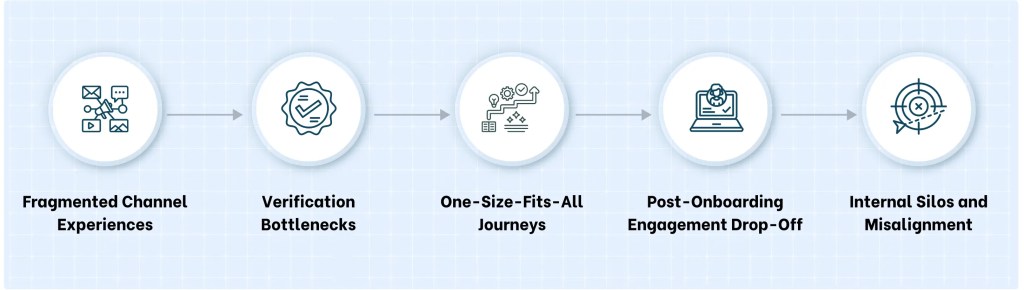
- Fragmented Channel Experiences
Customers forced to repeat information as they move between mobile, web, branch, and relationship managers face confusion and frustration. This disconnect leads to abandonment rates upto that can increase by 40–60%. - Verification Bottlenecks
Critical onboarding steps such as KYC, PAN, biometric, selfie, and eSign often stall due to unreliable third-party APIs and lack of fallback logic, resulting in drop-offs ranging from 5% to 30%. - One-Size-Fits-All Journeys
Standardized flows fail to accommodate customer diversity across different customer personas, geography, device, or segment excluding potential users and limiting conversions. - Post-Onboarding Engagement Drop-Off
After the initial push to acquire customers, many institutions lose engagement momentum. Up to 70% of new accounts become dormant within three months, leading to significant unrealized value. - Internal Silos and Misalignment
Disconnected teams across business, technology, operations, and compliance blur accountability and fragment the customer experience.
Patterns of High-Performance Journeys
Leaders distinguish themselves by embracing:
- Real-Time Journey Analytics: Complete transparency into every user touchpoint uncovers friction and informs rapid optimizations.
- Dynamic Swimlanes, Not Static Flows: Adaptive workflows respond intelligently in real time to user context, financial profiles, and behavior, replacing rigid form flows.
- Mobile-First Experience Hubs: As customers continue to get more adaptive to mobile usage, mobile apps serve as preferred platforms for onboarding, engagement, servicing, and growth.
- AI-Powered Personalization: Behavioral data and predictive algorithms deliver contextually relevant actions and offers at every interaction.
Join Our Newsletter
Get exclusive insights on banking, fintech, regulatory updates and industry trends delivered to your inbox.
Roadmap: Turning Insight Into Impact
- Prioritize and Map:
Select your highest-value segment and chart their end-to-end journey. Identify major friction points using behavioral data rather than assumptions. - Form Cross-Functional Teams:
Bring together representatives from business, technology, product, and operations with joint KPIs and ownership. - Design Targeted Solutions:
Focus on quick wins that address top friction points and prove ROI, while laying groundwork for scalable improvements. - Measure and Iterate:
Leverage real-time analytics dashboards to track key metrics and continuously refine your approach.
For mid-market institutions, partnering with journey optimization platforms and leveraging digital solutions facilitates access to enterprise-grade capabilities without the prohibitive costs of custom builds.
The New Frontier: Contextual Intelligence
Beyond personalization lies contextual, adaptive intelligence:
- Onboarding flows that morph instantly in response to user behavior and device.
- Seamless cross-device journey continuity that maintains experience fluidity.
- Predictive engagement models that anticipate needs before customers articulate them.
- Smart, blended self-service and human support based on interaction context.
The Business Impact: Proven Results
Organizations committed to journey optimization report:
- 30-35% increase in onboarding completion rates
- 25-30% more product activations within 30 days
- Upto 40% reduction in customer support volume
- 25% uplift in customer lifetime value
These numbers underscore journey excellence as a critical growth lever.
Conclusion: Start Small, Scale Fast
In a world where customer expectations continuously rise and switching costs fall, mastering frictionless, contextual journeys is no longer optional it is the foundation of lasting competitive advantage.
Begin by selecting one customer journey to perfect. Remove friction, embed accountability, and scale learnings enterprise-wide. Each seamless interaction you engineer transforms the customer relationship into a powerful engine for sustainable growth.