Corporate cards for SMEs could become the next major fintech infrastructure play. Explore how B2B cards, spend management platforms, and...
Know moreIndia’s Insurance Sector: A Digital Revolution in the Making
Introduction
The Indian insurance sector is undergoing a significant transformation, driven by digital innovation, regulatory advancements, and evolving customer expectations. With the push for financial inclusion and technology-driven efficiency, insurers are embracing end-to-end digitization—from policy sourcing to claims management. This edition of our newsletter explores the key trends, government initiatives, and emerging technologies reshaping the future of insurance in India, along with a lifecycle approach to understanding digital adoption at various stages.
1. Industry Growth & Market Potential
India’s insurance market, currently valued at over USD 131 billion, is projected to grow at a CAGR of 12-14% over the next five years (IRDAI, 2024). The sector is expanding rapidly due to increased penetration, favorable demographic shifts, and evolving customer preferences. Notably:
- Life insurance penetration stands at 3.2% of GDP, while non-life insurance is at 1.0%, indicating significant headroom for growth.
- Government schemes like Pradhan Mantri Jeevan Jyoti Bima Yojana (PMJJBY) and Ayushman Bharat have enhanced insurance coverage across diverse demographics.
2. Regulatory & Government Initiatives Driving Growth
The Insurance Regulatory and Development Authority of India (IRDAI) has been instrumental in shaping a more robust and customer-centric insurance landscape. Key regulatory developments include:
- Bima Sugam: The soon-to-be-launched digital marketplace will streamline policy distribution, offering customers a seamless experience while improving transparency.
- New Sandbox Regulations: Facilitating InsurTech innovation by allowing firms to test new products and services under regulatory supervision.
- FDI Liberalization: Increased the foreign direct investment (FDI) cap to 74%, boosting capital inflow and technological advancements.
- Composite Licenses: Allowing insurers to offer life, health, and general insurance under a single entity, simplifying customer access and improving cross-selling opportunities.
- Solvency Norms Relaxation: Recent reforms reducing capital requirements for insurers aim to enhance liquidity and encourage market expansion.
3. Challenges in the Current Insurance Journey
Despite rapid digitalization, insurers face significant challenges in streamlining their operations and customer journeys:
- Legacy Systems & IT Infrastructure: Many insurers still rely on outdated systems, making digital integration complex and costly.
- Fragmented Data & Limited Analytics: The lack of centralized, real-time data makes it difficult to personalize policies and detect fraud effectively.
- Regulatory Compliance Complexities: Meeting evolving regulatory requirements, such as data privacy norms, increases operational burdens.
- Low Digital Literacy & Customer Awareness: Many customers, especially in rural areas, struggle with navigating digital insurance platforms.
- Cybersecurity Threats: As digital adoption rises, insurers must strengthen their cybersecurity measures to protect sensitive customer data.
- Slow Claims Settlement Process: Manual processes and verification delays continue to impact customer satisfaction and trust
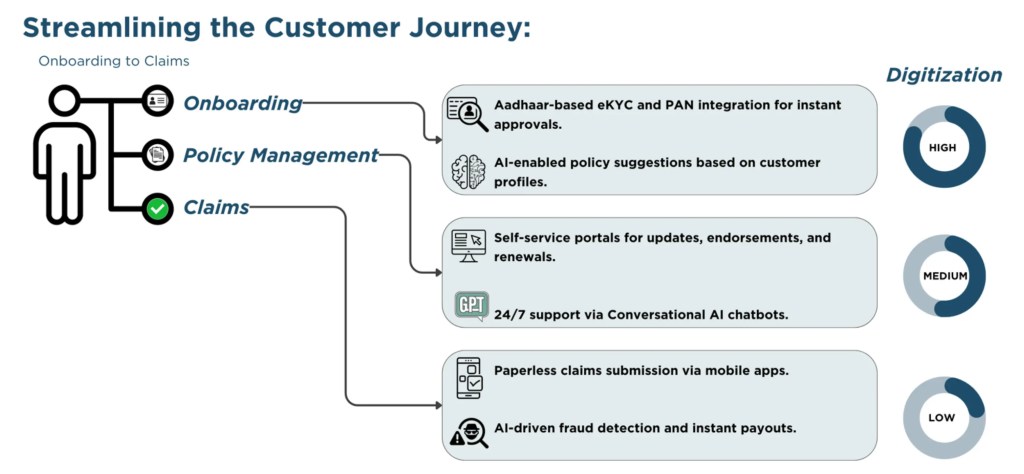
4. Digital Transformation: The Insurance Lifecycle Approach
To understand the impact of digital transformation, let’s analyze the insurance lifecycle and the level of digital adoption at each stage:
A. Customer Acquisition & Onboarding:
Digital channels account for less than 2% of insurance distribution in rural areas but are growing rapidly in urban centers.
AI-driven chatbots and robo-advisors are streamlining policy recommendations and reducing customer acquisition costs.
eKYC and Aadhaar-based verification are eliminating paperwork and improving turnaround times for policy issuance.
B. Policy Issuance & Underwriting:
AI and ML models are enhancing underwriting precision by analyzing vast datasets, including credit scores and health records.
Blockchain-based smart contracts are improving policy transparency and reducing fraud.
Embedded insurance models are increasing penetration through partnerships with e-commerce and fintech platforms.
C. Policy Servicing & Customer Engagement:
Omnichannel support with AI-driven virtual assistants is improving query resolution and reducing reliance on call centers.
IoT-driven dynamic pricing models for health and motor insurance are making policies more personalized.
Self-service portals and mobile apps are allowing customers to track policy details and initiate service requests seamlessly.
D. Claims Processing & Settlement:
AI-powered fraud detection systems are reducing false claims and improving settlement speed.
Drones and satellite imagery are being leveraged for real-time damage assessment in crop and property insurance claims.
Blockchain-based claims automation is ensuring tamper-proof and transparent settlement processes, reducing disputes.
E. Renewals & Retention:
Predictive analytics is enabling proactive customer retention strategies, reducing churn rates.
Personalized recommendations for policy upgrades and cross-selling are increasing customer lifetime value.
Mobile notifications and automated reminders are ensuring timely renewals, reducing policy lapse rates.
5. The Need for End-to-End Digitization
With rapid digitization, insurers must transition from traditional legacy systems to an agile, fully digital framework. This involves:
- Automating claims processing with AI-driven decision-making.
- Deploying digital KYC and onboarding solutions for frictionless customer acquisition.
- Enhancing customer engagement via chatbots, AI-driven advisors, and omnichannel platforms.
- Strengthening cybersecurity frameworks to safeguard customer data and digital transactions.
- Integrating AI-driven automation to reduce operational inefficiencies and improve response times.
Conclusion: Embracing the Future
India’s insurance industry is at the cusp of a digital revolution, with regulatory backing and cutting-edge innovations paving the way for end-to-end transformation. The lifecycle approach to digital adoption highlights the sector’s progression toward seamless, tech-driven operations. However, insurers must proactively address existing challenges—legacy systems, cybersecurity threats, regulatory compliance, and customer education—to fully capitalize on digital transformation.
RELATED POSTS

Data Readiness in BFSI: Building the Intelligence Layer for AI
India’s BFSI sector is shifting from data accumulation to intelligence-ready infrastructure. Explore how real-time pipelines, lakehouses, and governance power AI.
Know more
Inside India’s Merchant Payments Ecosystem Shift
India’s merchant payments landscape is shifting beyond transactions. Explore how UPI, infrastructure, banks, and platforms are redefining value and control.
Know more