Getting Digital Right Starts with the Right Architecture
India’s financial services sector has embraced digital transformation at an unprecedented pace, marked by the rise of UPI, mobile-first banking, and AI-powered innovations. As fintechs collaborate with traditional players and customers increasingly expect always-on, hyper-personalized services, technology has become the new competitive differentiator.
Amid this progress, a critical enabler often goes under appreciated: Enterprise Architecture (EA). Not all challenges stem from poor architecture, but a strong architectural foundation plays a pivotal role in enabling technology to scale, integrate, and evolve in line with business goals.
Enterprise Architecture isn’t about adding complexity. It’s about creating coherence—aligning innovation with intention, and enabling transformation to be faster, more strategic, and more sustainable.
Enterprise Architecture isn’t just technical documentation. It’s the digital blueprint that aligns your business goals with systems design across four layers: business, data, applications, and infrastructure. It helps financial institutions go beyond chasing shiny tools—cloud, AI, APIs, RPA—and builds the foundation to integrate them meaningfully and securely. It serves as the crucial link between an organization’s digital aspirations and its ability to deliver them with consistency, clarity, and control.

Together, these pillars enable transformation that is structured, scalable, and sustainable.
Enterprise Architecture in Action: Why It Matters Now
Enterprise Architecture (EA) plays an increasingly vital role as BFSI institutions strive to become more agile, scalable, and resilient. With surging UPI volumes, rapid fintech partnerships, and rising regulatory scrutiny, Enterprise Architecture serves as a compass for navigating complex digital transformations without losing alignment or control.
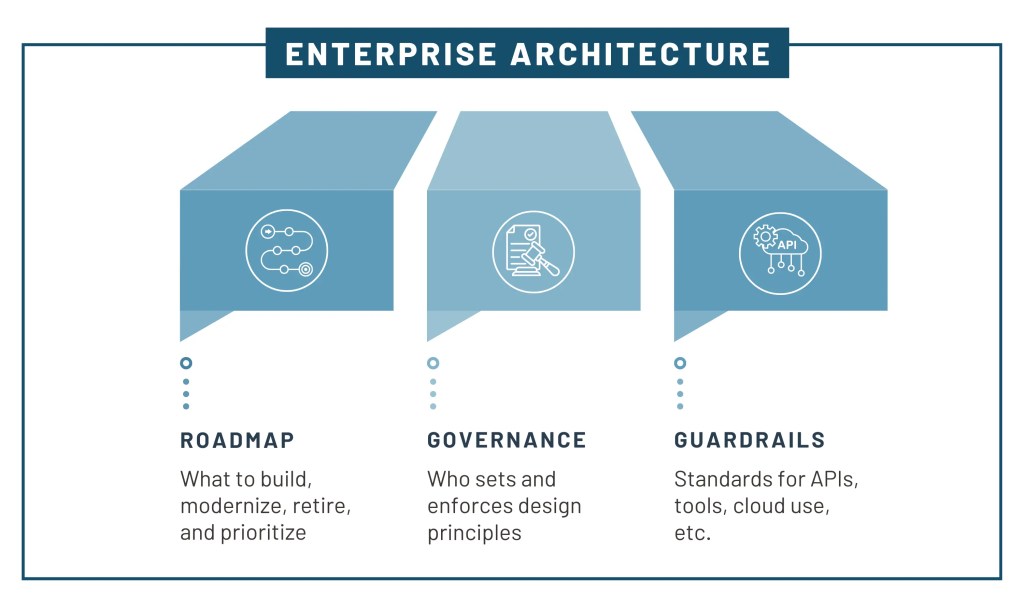
In practical terms, Enterprise Architecture enables:
- Legacy modernization through structured, phased transformation—enabling newer digital services without disrupting critical legacy systems.
- Connected ecosystems via standardized interfaces, enabling integration with fintechs, digital public infrastructure, and third-party platforms.
- Faster time-to-market by establishing reusable architecture components, which reduce duplication and shorten development cycles.
- Agile decision-making with real-time visibility into application interdependencies, data flows, and technology risks.
- Compliance-by-design through embedded controls, audit trails, and data governance frameworks that are integral to systems—not bolted on later.
By bridging strategy and execution, Enterprise Architecture transforms fragmented digital efforts into a coherent enterprise-wide approach—empowering financial institutions to respond to change with speed and structure.
Enterprise Architecture: A Force Multiplier for Strategic Innovation
Enterprise Architecture isn’t just a framework for operational efficiency—it’s a powerful accelerator for innovation at scale. As BFSI institutions expand their digital footprints, Enterprise Architecture acts as a strategic enabler for the next wave of transformation:
- GenAI at Scale: Enterprise Architecture ensures AI-driven use cases—like hyper-personalized recommendations, automated credit scoring, and intelligent customer service—are built on secure, real-time data flows, integrated into enterprise systems, and governed with the right risk and compliance frameworks.
- Open Banking Readiness: Enterprise Architecture provides the architecture and governance needed to publish APIs confidently, onboard partners quickly, and expose services safely to third-party developers—accelerating participation in the Account Aggregator framework and broader digital public infrastructure.
- Embedded Finance Enablement: From BNPL integrations in e-commerce to co-lending with fintechs, Enterprise Architecture enables banks to embed services externally without exposing internal risk. By decoupling channels from core services, Enterprise Architecture makes external innovation frictionless.
- Developer Agility with Structure: Enterprise Architecture empowers product and tech teams to innovate faster with shared playbooks—reference architectures, API templates, CI/CD pipelines, and modular components that accelerate delivery while ensuring alignment with enterprise goals.
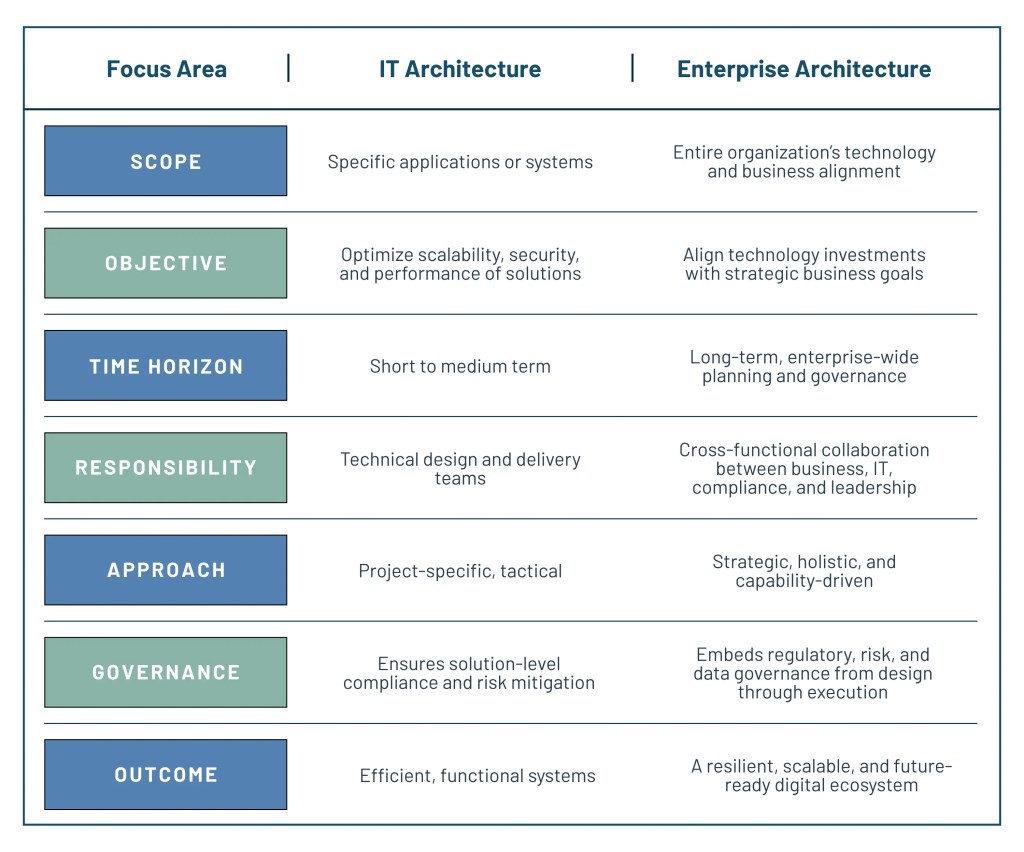
Enterprise Architecture vs IT Architecture: A Strategic Distinction
Common Enterprise Architecture Frameworks and Real-World Adoption
To institutionalize Enterprise Architecture, many financial institutions adopt globally recognized frameworks that offer structure, best practices, and standardization:
- TOGAF (The Open Group Architecture Framework): A widely adopted methodology that offers a step-by-step approach for developing and managing enterprise architecture.
- Zachman Framework: A taxonomy-based model that defines enterprise architecture based on six perspectives and six interrogatives.
- FEAF (Federal Enterprise Architecture Framework): Used by U.S. federal agencies and adapted by some BFSI organizations for strategic alignment and cross-functional governance.
- Bian (Banking Industry Architecture Network): Specifically designed for the banking sector, BIAN promotes standard service domains and interoperability across systems.
For instance, a Digital-First Small Finance Bank recently initiated a comprehensive enterprise architecture review to align its operating model with TOGAF 10 standards. The initiative was designed to strengthen governance, improve compliance posture, and create a scalable architectural foundation. Key components of the engagement included:
Assessing the Current State: Evaluating business, data, application, and technology layers against TOGAF 10 principles.
Tech and Security Posture Review: Analyzing existing systems and security controls to identify gaps.
Compliance Roadmap: Defining actionable steps toward architecture maturity and regulatory alignment.
Control Framework Design: Recommending governance models, templates, and processes to institutionalize architecture discipline.
By combining structured methodologies with deep architectural expertise, The Digital Fifth enabled the Small Finance Bank to:
Establish a TOGAF 10-aligned Enterprise Architecture foundation to guide future technology investments and product modernization.
Embed architecture governance as an institutional discipline, improving transparency, cross-functional coordination, and design consistency.
Create a clear path to compliance and audit-readiness through codified architecture practices.
Accelerate enterprise-wide transformation by linking architectural principles directly to digital initiatives and core business outcomes.
At a time when digital finance is growing faster than ever, structure is as critical as speed. Enterprise Architecture provides the connective tissue that helps BFSI firms scale smarter, govern better, and innovate safely.
It’s time to move Enterprise Architecture from a backroom document to a boardroom conversation—because the next phase of transformation won’t be powered by tools alone, but by the architecture that binds them.