
Most compliance failures aren’t policy issues - they’re execution gaps. Learn why compliance breaks on the ground and how to...
Know moreDigital Transformation in Insurance
India’s insurance sector is not just a financial safety net—it’s a critical economic development engine. Insurance strengthens the country’s financial resilience by enabling individuals and businesses to manage risk. At the same time, premiums mobilised by insurers are channelled into long-term investments, supporting capital formation and infrastructure growth.
The industry also drives employment generation, offering opportunities from field agents to underwriters, and plays a key role in promoting household savings and structured investments, primarily through life insurance. Additionally, it aligns closely with national priorities, supporting government schemes like Ayushman Bharat and PMJJBY that advance financial inclusion and social protection.
With total premiums reaching ₹11.2 trillion in FY2023–24, yet penetration still at just 3.7% of GDP, the sector’s potential remains vastly untapped. As India eyes becoming the 6th largest insurance market by 2032, modernising how insurers acquire and serve customers will be central to unlocking this growth.
This indicates immense untapped potential in bringing more of the population under insurance cover. Projections show India could become the 6th largest insurance market by 2032, driven by rising incomes and digital-focused innovation. Insurance is thus both an economic cornerstone and a sector ripe for expansion, especially as regulators push for “Insurance for All” by 2047 and greater financial inclusion.
In this article, The Digital Fifth presents a clear, actionable roadmap that translates DPDPA’s principles into practical steps for compliance, backed by examples, tools, and industry-tested approaches. It outlines the five key pillars that institutions must focus on, covering regulatory mandates and implementation insights.
Future Bright:
The Insurance segment is expected to get impetus from regulatory changes in the coming days. Coupled with policy support and new age digital / technology, this segment is at an inflexion point for massive growth.
How Technology Will Transform Insurance: A Dual Lens on Acquisition and Claims
The insurance sector is poised for significant digital disruption in the coming years, driven by a powerful combination of regulatory reform and technological innovation.
Two key areas stand out:
- New Customer Acquisition which will undergo a significant shift with the enforcement of the Digital Personal Data Protection Act (DPDPA). This regulatory framework demands a complete overhaul of how insurers collect, use, and manage customer data. Compliance will no longer be optional—it will become a core part of the acquisition strategy.
- Claims Processing, where AI is expected to have a highly positive and transformational impact. From fraud detection to instant document verification and automated claims settlement, AI has the potential to improve speed, accuracy, and customer satisfaction dramatically.
The following sections explore these changes for insurers, one segment at a time.
The Double Impact of DPDPA on Customer Acquisition
The Digital Personal Data Protection Act (DPDPA) introduces a new era of responsible data handling. For insurers, it brings opportunities and challenges in how new customers are identified, engaged, and onboarded.
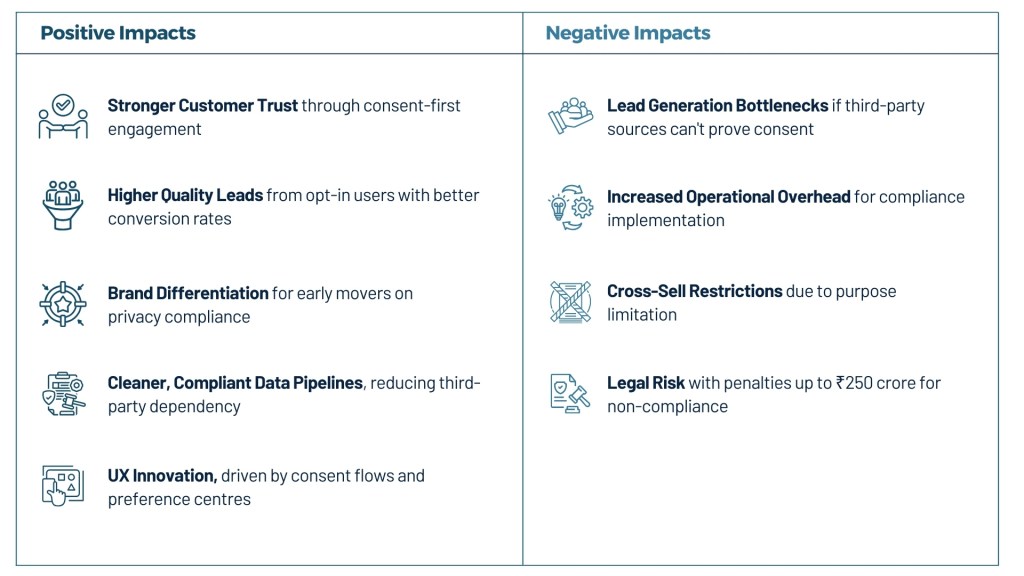
To summarize, DPDPA will force insurers to evolve from a volume game to a value game, where quality, consent, and compliance define acquisition success.
AI in Claims Processing: From Bottlenecks to Breakthroughs
Claims have long been the make-or-break moment in an insurance customer’s journey. Historically riddled with delays, paperwork, and manual checks, the process has often fallen short on efficiency and experience. AI is reshaping this critical function, making claims faster, more innovative, and more customer-centric.
Here’s how AI is driving the shift:
- Real-Time Triage: Instantly classifies claims for fast-track or review
- Document Intelligence: Uses OCR/NLP to extract and verify claim data
- Fraud Detection: Flags anomalies and policy misuse in real time
- 24×7 Claim Support: Chatbots handle FNOL, updates, and follow-ups
- Self-Learning Systems: Improve with every claim to optimise future workflows
AI is not just enhancing claims—it’s turning them into a competitive differentiator. For insurers ready to modernise, this is where loyalty, trust, and cost leadership converge.
DPDPA + AI: A Catalyst for a Smarter, Safer Insurance Ecosystem
The convergence of DPDPA and technological innovation is set to usher in a new era of trust, transparency, and operational excellence for India’s insurance sector.Together, these forces are not just compliance mandates or digital tools—they represent a structural reset of how the insurance industry engages with its customers and delivers its core promise of protection.
Here’s what this dual shift enables for the industry:
- Transparency Builds Trust: Consent-led models + AI personalisation create meaningful interactions
- Growth Becomes Smarter: Data minimisation + behavioural intelligence = better targeting & retention
- Operations Get Leaner: AI automation reduces turnaround, effort, and human error
- Risk is Managed Proactively: AI-driven anomaly detection improves fraud control and underwriting
- Compliance Becomes Competitive: Early adopters of DPDPA will lead on ethics and digital maturity
This is the foundation of the next-generation insurer: compliant by design, intelligent by default, and trusted by the customer.
As these forces converge, the questions for insurers are no longer “if” but how and how fast they should transform. That’s why India InsurTech Summit 2025 is bringing together the sharpest minds—CXOs, policymakers, insurtech innovators, and AI experts—to unpack what this future looks like.
Expect insights on:
- Implementing DPDPA-compliant acquisition strategies
- Embedding Gen AI and Agentic AI into distribution and servicing
- Real-world case studies from top insurers
- Policy and ecosystem alignment for Insurance 2.0
RELATED POSTS
The Corporate Card Opportunity Nobody’s Talking About | The Next B2B Fintech Infrastructure Play
Corporate cards for SMEs could become the next major fintech infrastructure play. Explore how B2B cards, spend management platforms, and...
Know more
Data Readiness in BFSI: Building the Intelligence Layer for AI
India’s BFSI sector is shifting from data accumulation to intelligence-ready infrastructure. Explore how real-time pipelines, lakehouses, and governance power AI.
Know more