The digital financial landscape is evolving at a pace never seen before fintech integrations, API ecosystems, real-time services, and AI-driven operations are redefining how institutions function. Against this backdrop, the RBI’s 2024 Guidance Note on Operational Risk Management (ORM) and Operational Resilience signals a powerful shift.
Compliance is no longer the goal. Demonstrable, embedded resilience is
Why Operational Resilience Matters More Than Ever
Today’s operational landscape is defined by increasingly complex threats i.e., from sophisticated cyber incidents and rapid fintech disruptions to cloud failures, data breaches, and multi-party ecosystem breakdowns. The RBI’s updated guidance extends its applicability beyond Scheduled Commercial Banks to include All Commercial Banks, Non-Banking Financial Companies (NBFCs), Co-operative Banks, and All India Financial Institutions (AIFIs), signifying a sector-wide push for enhanced resilience
Many institutions face recurring challenges with ORM frameworks that require an in-depth interdependency mapping with sophisticated Business Continuity Plans (BCPs) that require rigorous stress testing, limited testing maturity, and gaps in cyber integration and third-party dependency management. This highlights the gap between policy and practice. In response, the RBI has extended the guidance’s applicability to Scheduled Commercial Banks, Co-operative Banks, NBFCs, and All India Financial Institutions (AIFIs). This marks a sector-wide call to arms for institutional resilience that goes beyond risk documentation.
Policy Fatigue vs Practical Action
Most frameworks look perfect on paper but falter under pressure & in real world scenarios. Testing maturity, cyber security alignment, and identifying interdependencies along with gaps remain weak spots.
Building Operational Resilience: A Multi-Pillar Approach
Building resilience moves beyond merely identifying risks to actively enhancing an institution’s capacity to absorb, adapt, and swiftly recover from disruptions to its critical operations
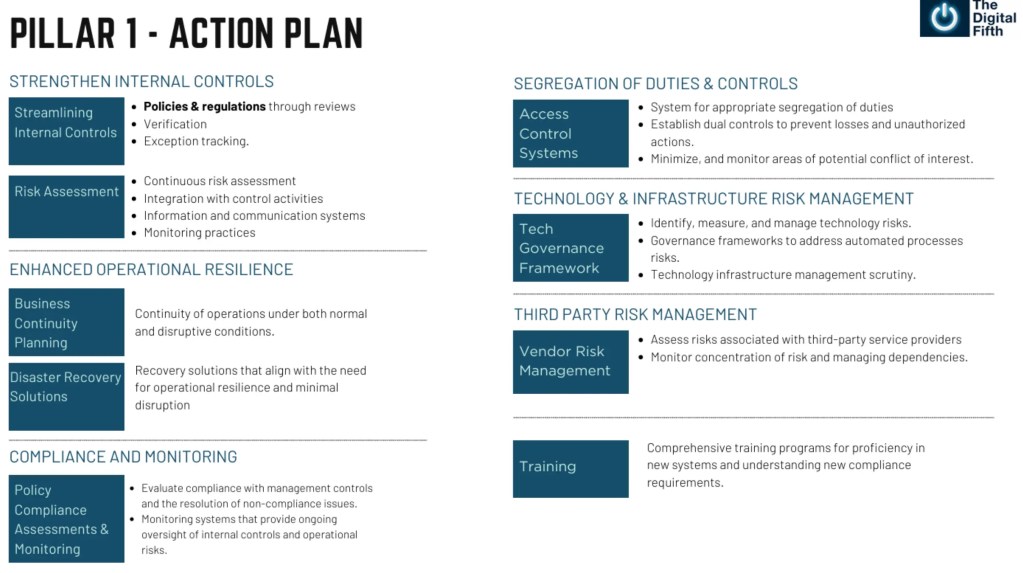
Pillar One: Prepare & Protect – Identifying Operational Risks: The Foundation of Resilience
Effective operational resilience begins with a robust approach to identifying and assessing risks. The regulators guidance emphasizes that senior management must comprehensively identify and assess operational risks across all products, activities, processes, and systems. This includes continuous evaluation of internal and external threats and potential failures to proactively manage vulnerabilities in critical operations.
Key tools and practices for identifying operational risk include:
- Operational Risk Event Data: Analyzing historical incidents and losses to understand patterns and root causes.
- Self-Assessments: Regular internal evaluations of risk exposures and control effectiveness.
- Benchmarking & Comparative Analysis: Learning from industry best practices and peer performance.
- Scenario Analysis & Testing: Conducting “severe but plausible” hypothetical scenarios to identify vulnerabilities and test response mechanisms.
- Event Management Metrics: Tracking key indicators of risk events and near misses.
- Mapping Interconnections & Interdependencies: Thoroughly documenting the relationships between people, technology, processes, information, and infrastructure, as well as internal and third-party dependencies, to identify potential single points of failure and concentration risks.
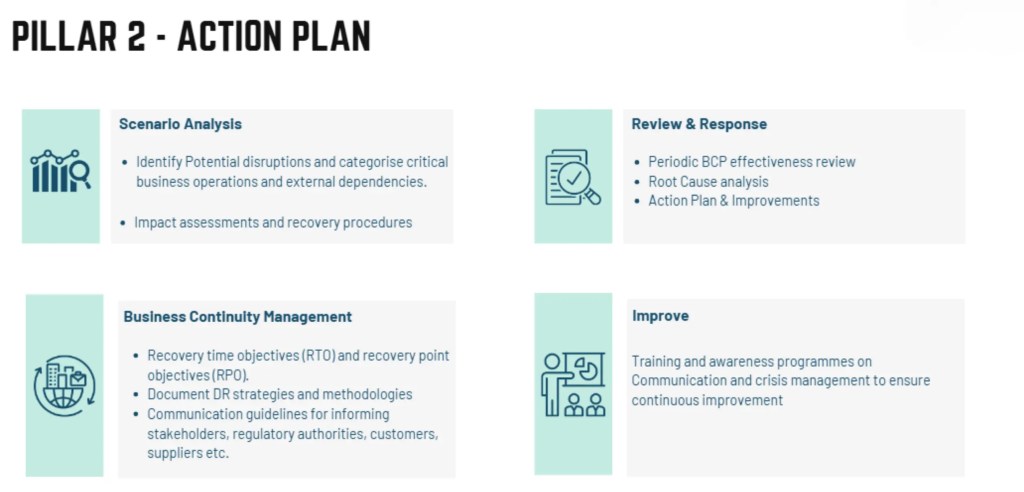
Pillar Two: Build Resilience focuses on practical measures:Business Continuity Planning & Testing (BCP&T): Developing robust plans aligned with the operational resilience framework and regularly testing them through realistic scenarios. This includes defining Recovery Time Objectives (RTOs) and Recovery Point Objectives (RPOs).
- Third-Party Dependency Management: Proactively assessing and managing risks associated with external service providers, including supply chain vulnerabilities and concentration risk.
- Incident Management: Establishing clear response and recovery plans for critical operation disruptions, with defined classification, prioritization, and resource assignment.
- Information and Communication Technology (ICT) including Cybersecurity: Implementing a robust ICT risk management program, aligned with the operational resilience framework, covering governance, security measures (like access controls and identity management), and continuous monitoring and testing of ICT infrastructure.
Pillar Three: Learn & Adapt ensures continuous improvement:
- Lessons Learned Exercises: Conducting post-incident reviews to identify root causes, document insights, and implement effective remediation measures.
- Continuous Improvement through Feedback Systems: Fostering a culture of learning and adaptation by establishing robust feedback mechanisms from all levels.
Learn Fast or Fall Behind

Learn Fast or Fall Behind
Operational resilience isn’t a one-time project. It’s a continuous capability. Institutions must build mechanisms to learn from disruptions, adapt frameworks, and bake feedback loops into governance.
Readiness and Annual Assessments: Proving Capability
The true test of operational resilience lies in an institution’s readiness, which must be validated through rigorous and regular assessments. The RBI emphasizes that monitoring and reporting of operational risk profiles and exposures should provide clear insights to the board, senior management, and business units. This includes reporting on key risk metrics, loss events, control effectiveness assessments, and mitigation strategies.
Annual Assessments and Periodic Reviews:
- Self-assessment Analysis: Institutions are advised to conduct regular self-assessments and update documentation to ensure ongoing compliance and reflect the latest risk management insights.
- Periodic Reviews, Audits & Reporting: A framework for periodic reviews, audits, and reporting is crucial to assess the operational risk framework and facilitate necessary adjustments by management. This includes regular review and approval of the business continuity plan by the Board of Directors, with strong involvement from senior management and business units, and regular review by the third line of defense (audit function).
- Scenario Testing and Simulations: Beyond theoretical readiness, institutions must regularly test their resilience strategies and recovery plans through diverse simulations to validate their effectiveness. This practical testing helps identify gaps between policies and actual capability.
- Compliance and Monitoring: Continuous monitoring systems are essential for providing ongoing oversight of internal controls and operational risks
The Digital Fifth Approach: From Strategy to Execution
At The Digital Fifth, we understand that achieving true operational resilience requires a holistic, integrated strategy. Our approach guides institutions through a structured journey:
- Identify: We begin with an initial assessment and risk identification, evaluating existing frameworks, documenting critical business processes for inherent risks, and classifying them across strategic, compliance, financial, technological, and human categories. A Business Impact Analysis (BIA) is performed on key applications to calculate critical metrics like RTO and RPO.
- Respond: This phase involves a comprehensive gap analysis between current practices and framework requirements, leading to actionable recommendations and a clear action plan with timelines and responsibilities. Response strategies are integrated with BCPs and aligned with business strategy.
- Protect: We assist in framework development and standardization, revising risk management policies to embed risk considerations, incorporating industry standards, and leveraging technology to automate controls.
- Recover: This final phase focuses on implementation and change management, rolling out new controls, defining employee roles in recovery, and establishing a framework for periodic reviews, audits, and reporting to ensure continuous assessment and necessary adjustments.